
What Cayuga County Property Tax Records Show
Cayuga County property tax records split into two layers. The municipal assessment roll describes each parcel. County systems build the tax rolls, bills, payment history, and delinquency records. Begin in PROS. There you can pin down the parcel, assessing unit, owner of record, inventory, and assessment. From there, follow the tax-bill route through Real Property Services and the Treasurer. Dates matter throughout. An assessment describes the parcel for one roll year. A payment screen describes a bill and its later status.
| Field | What It Shows | Where |
|---|---|---|
| Assessed value | The value placed on the municipal assessment roll before exemptions are deducted | City or town assessor and PROS |
| Full value context | The assessment interpreted through the municipality's level of assessment or equalization rate | Assessment roll and NYS ORPTS data |
| Exemptions | STAR or other approved reductions used to reach taxable value | Local assessor |
| Tax bill and status | Levies, amount billed, payment history, and any unpaid balance shown for that bill | Cayuga County Treasurer links |
| Taxing jurisdictions | The municipal, school, county, and applicable special-district portions tied to the parcel | Tax roll and bill |
Avoid collapsing these fields into a single number. Exemptions generally shift taxable value, not the assessed value beneath it. The bill then stacks levies from every jurisdiction serving the parcel. A recorded sale price belongs to the deed and transfer record instead. Neither an assessment nor an old sale equals a current appraisal. Matching the SWIS and SBL matters. It keeps a near-identical parcel number in another assessing unit from standing in for the property you mean.
Looking Up a Cayuga County Tax Bill
A solid Cayuga County tax-bill lookup starts by resolving the address to a parcel. PROS and TMO can supply the municipality and SBL. That helps when an address is incomplete. It also helps when a mailing label misleads. The county Treasurer page links the tax-search and payment-history routes. Keep the roll year and bill year in view the whole way. A result can name the right parcel. But the wrong year can give the wrong answer on value, exemptions, or payment status.
- Search PROS by the available address or owner, or use TMO to identify the correct parcel polygon.
- Copy the municipality, SWIS, SBL, owner spelling, and assessment-roll year from the matching parcel.
- Open the tax-bill or payment-history link and confirm that the same municipality and parcel number appear.
- Read the bill year, taxing jurisdictions, billed amount, payment entries, and any balance as separate fields.
- Contact the Treasurer about payment or delinquency and the local assessor about value or exemptions.
- Assessed value
- The value entered on the assessment roll by the city or town assessing unit.
- Levy
- The amount raised for a taxing purpose and allocated through the applicable tax rate; it is not the property's value.
- Taxable value
- The assessment remaining after the exemptions approved for that roll are applied.
- Tax lien
- A legal claim associated with unpaid tax; confirm delinquency and recorded filings with the responsible county offices.
Appealing a Cayuga County Assessment
A Cayuga County assessment challenge starts with the local assessor, not the Treasurer. Look at the tentative roll while the administrative calendar is still open. Ask how the parcel was valued, and compare the inventory to the actual property. New York's RP-524 complaint form brings the dispute to the Board of Assessment Review. Useful evidence includes recent arm's-length sales. A qualified appraisal also helps. So do photographs of condition, corrected inventory, or a calculation showing unequal assessment.
Use the local calendar. Auburn and the county's towns publish rolls on different dates, so confirm Grievance Day and the RP-524 filing deadline with the assessor for the parcel's municipality.
Owners should separate factual corrections from valuation disputes. A wrong acreage figure, building inventory, exemption entry, or municipality often shows up in the parcel record itself. A claim of excessive or unequal value needs support tied to the valuation date and the local level of assessment. The final roll controls the assessment behind the bill. Waiting until a tax payment comes due may be too late for that year's ordinary administrative review.
Cayuga County Assessment Calendars Depend on Municipality
Auburn publishes its tentative roll April 1 and its final roll June 1. Most Cayuga County towns use May 1 and July 1. That gap sets each review window. It explains why two parcels in the same county can run on different schedules. The city or town assessor keeps the official assessment roll. County Real Property Services backs countywide maps, roll data, tax rolls, and bills.
Assessed, Taxable, and Full Value in Cayuga County
Assessed value is the local roll figure. Taxable value generally means assessed value minus allowed exemptions. Full value comes into focus through the municipality's level of assessment and the state equalization rate, which compares total assessed value with total market value. These numbers answer different questions. None is an appraisal or a promised sale price. PROS adds inventory and comparable-sale context, while the Treasurer's system handles the bill and payment history. The official PROS welcome page shown here provides the countywide assessment search entry.
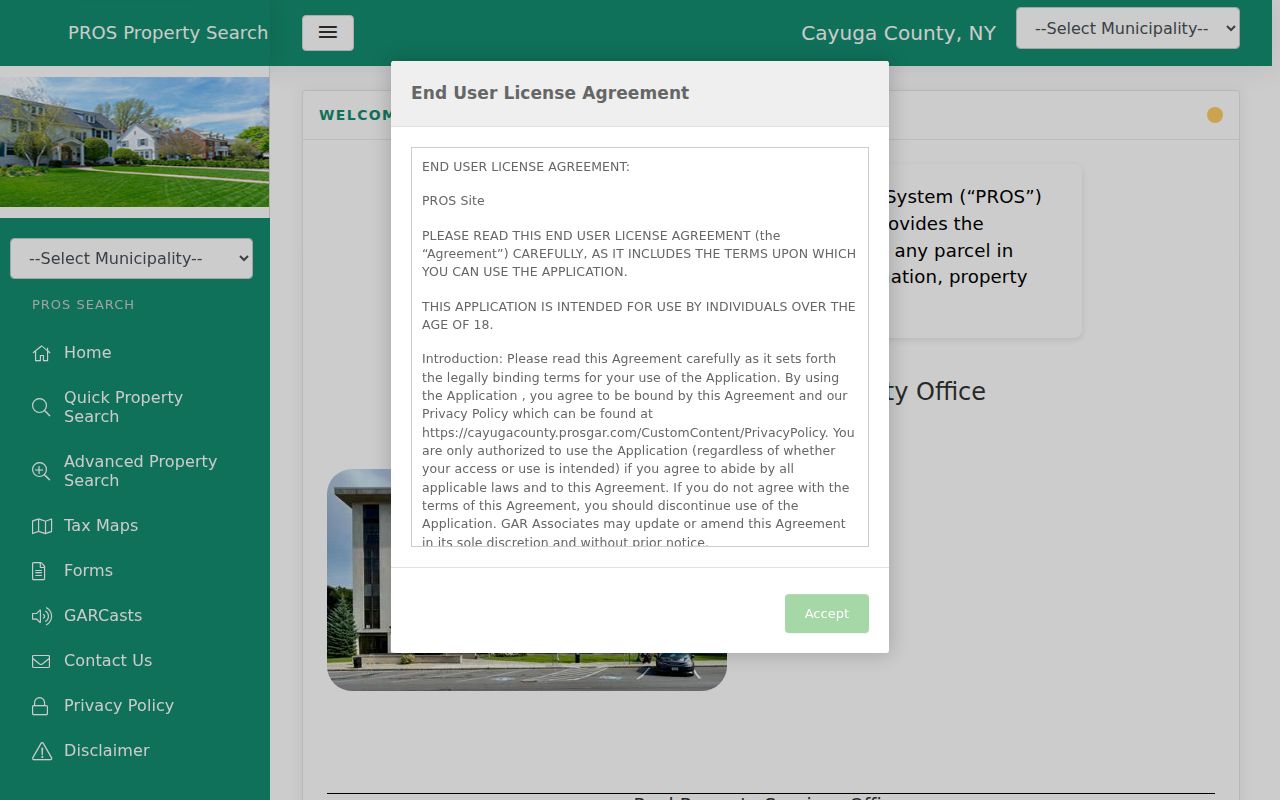
Use the returned municipality and parcel key when asking the local assessor about a roll value. The parcel key ties your question to one property.
Cayuga County Exemptions, Grievances, and Delinquency
Cayuga County lists STAR, senior, veteran, disability, agricultural, solar, wind, and farm-waste exemptions. These programs trim taxable value. Auburn sets its renewal deadline at February 1. Towns and villages generally use March 1. An owner challenging an assessment files the RP-524. The claim can be backed with sales, an appraisal, or evidence of unequal assessment. Delinquency is a separate Treasurer matter. The taxpayer guide describes a 5 percent penalty and monthly interest. It also covers a November filing with the Clerk and an annual tax-foreclosure auction.
Auburn Exemption Dates in Cayuga County Property Tax Records
Auburn sets its exemption deadline on February 1. That local date matters. Towns and villages in Cayuga County use March 1 instead. So a single March rule can mislead. The deadline also concerns the assessor's exemption process, not the eventual tax bill payment. One parcel can carry an assessed value. It can also carry several exemptions and a lower taxable value on the same roll. Do not assume a program carried over. Read the exemption name and roll year on the current record.
STAR, senior, veteran, disability, agricultural, solar, wind, and farm-waste programs vary. Each carries its own qualifications and forms. The county's exemption page routes you to the right material. The local assessor decides how an application affects the municipal roll. Ownership or use changes raise a different question: does the exemption still apply? A deed recorded close to the filing date does not automatically update every exemption field. Nor does it establish eligibility. Ask the assessor directly when in doubt.
Delinquent Cayuga County Taxes and the Clerk Filing
A paid bill and a delinquent record answer different questions. The Treasurer's taxpayer material lays out a 5 percent penalty once the collection period closes. Monthly interest follows after that. It also covers filing the delinquent list with the County Clerk in November. Start with the Treasurer's current material. Then turn to the filed list or Clerk record when the historical status or formal filing matters. Confirm the tax year, parcel number, and amount. A later payment can change the balance without erasing the history.
A delinquent entry does not mean the parcel is on the market tomorrow. Notice, redemption, court, and auction steps are separate stages. Cayuga County keeps an archive of delinquent lists. It also maintains a separate Tax Foreclosure Auction page with the annual catalog, bidder procedures, and results. Those sources document the process as it unfolds. But they cannot replace review of the proceeding or the terms published for a given auction.
The Cayuga County Tax-Foreclosure Auction Record
The annual auction materials help trace distressed-property history once ordinary bill research is done. Use the catalog to identify the parcel offered. Use the published procedures to understand that sale. Use the results to see the reported outcome. Then circle back to SearchIQS for any deed recorded after the sale. Go to PROS for the later roll entry. The auction result, deed recording, and assessor update can land on different dates. One source cannot stand in for all three.
For a due-diligence timeline, save the last paid-bill entry and the delinquent-list filing. Keep the foreclosure case or notice reference, the auction catalog entry, the result, and the later deed. That sequence keeps a tax collection event separate from ownership evidence. It also explains why an older Treasurer page may name one party. The newest deed and later assessment roll name another.
Why the Cayuga County Final Roll Controls the Bill
The tentative roll is where review pays off. It gives an owner time to inspect the assessment and pursue administrative correction. Once the assessor finishes changes, the Board of Assessment Review process runs its course. Then the final roll supplies the values used in tax-roll preparation. A later correction, court order, or authorized change can still touch a record. A complaint made only to the billing office, though, will not revise the underlying assessment.
Keep both versions of the evidence when chasing a discrepancy. Record the tentative or final roll year. Note the assessment and taxable value, each exemption, the tax bill year, and the date of any payment-history entry. Send valuation questions to the municipal assessor. Send billing and delinquency questions to the Treasurer. This division of labor is the key to reading Cayuga County property tax records. It keeps the office that values land separate from the office that collects the charge.