
How to Search Cayuga County Property Records
No single database holds everything. Cayuga County splits property information across PROS, the County Clerk's SearchIQS index, municipal assessment and tax offices, and the county GIS viewer. Each answers a different question. The roll tells you what the assessor valued. The deed records tell you who transferred what. The map tells you where the lines sit.
Before comparing results, read the date, municipality, parcel key, and source on every entry. A current roll field can lag a newly recorded deed. A mapped line is a reference, never a surveyed boundary.
- Open the relevant official Cayuga County portal and search with the most exact key available.
- Open the parcel or document result and save its owner, SBL, date and recording reference.
- Cross-check the same property in the next official record system.
- Compare dates and jurisdictions, then note any conflict that needs custodian review.
- Request the original or certified record when the online index is incomplete.
Cayuga County Property Records Offices
Cayuga County keeps its property records in several places. PROS handles assessment data. The County Clerk's SearchIQS index covers recorded instruments. Municipal assessment and tax offices keep the local rolls and bills. The county GIS viewer maps the parcels. Match your question to the right custodian.
Cayuga County Recorder / Register of Deeds
95 Tivoli Street
Auburn, NY 13021
315-253-1271
Cayuga County Assessor / Appraisal District
95 Tivoli Street
Auburn, NY 13021
315-253-1271
Cayuga County Treasurer / Tax Collector
95 Tivoli Street
Auburn, NY 13021
315-253-1271
Types of Cayuga County Property Records
The records fall into distinct types. Deeds and other recorded instruments live with the County Clerk. The assessment roll and tax bill belong to the local assessing unit. Parcel lines and dimensions appear on the GIS map. Each record answers a different question about the same property.
| Record Type | What It Documents | Kept By | Access |
|---|---|---|---|
| Deeds | See the dated official Cayuga County record and verify the parcel key with its custodian | Cayuga County Clerk | See the dated official Cayuga County record and verify the parcel key with its custodian |
| Mortgages & liens | See the dated official Cayuga County record and verify the parcel key with its custodian | Cayuga County Clerk | See the dated official Cayuga County record and verify the parcel key with its custodian |
| Tax & assessment | See the dated official Cayuga County record and verify the parcel key with its custodian | local assessor and treasurer | See the dated official Cayuga County record and verify the parcel key with its custodian |
| Plats & parcels | See the dated official Cayuga County record and verify the parcel key with its custodian | Cayuga County GIS and recorded map custodians | See the dated official Cayuga County record and verify the parcel key with its custodian |
| Building permits | See the dated official Cayuga County record and verify the parcel key with its custodian | city building department | official online portal or direct request |
Think in terms of record type. A deed records a transfer. The tax roll records value and exemption. A plat or parcel map records shape and dimension. The assessor, recorder, and GIS viewer each publish one layer, so a complete property search stitches them together.
What Cayuga County Property Records Can and Cannot Tell You
These records answer ownership questions well. The deed records name the owner of record. The roll shows assessed value and exemptions. The tax bill shows what is owed. What they cannot do is settle legal title, fix a boundary, or certify a survey. Those jobs belong to professionals, not databases.
Lawful use. See the dated official Cayuga County record and verify the parcel key with its custodian
Cayuga County Deeds Reach Beyond the Online Cutoff
SearchIQS reaches back only to 1972. Cayuga County's own archive list places property deeds as far back as 1794. A blank web result does not erase that earlier chain. For book and page work before the cutoff, turn to the Clerk and Records Center. The New York State Archives holds a finding aid covering 145 microfilm rolls. The FamilySearch New York land collection helps where access permits.
Auburn adds one more bridge. Its city grantor run covers 1867 through 1898. That run can tie a modern parcel to an older owner name.
The September 2026 Cayuga County Map Change
Cayuga County replaced Tax Map Online in September 2026. Links embedded in older PROS pages can still point to the stale map. Open the current viewer from the county Tax Maps page instead. Then search the parcel again. The new service exposes parcel geometry, dimensions, acreage, coordinates, and lot-division layers. Table and export tools are described in county help. Those lines support tax administration and research. They are not a boundary survey.
The county PROS page shows the Quick Property Search entry. It starts a Cayuga County property records lookup.
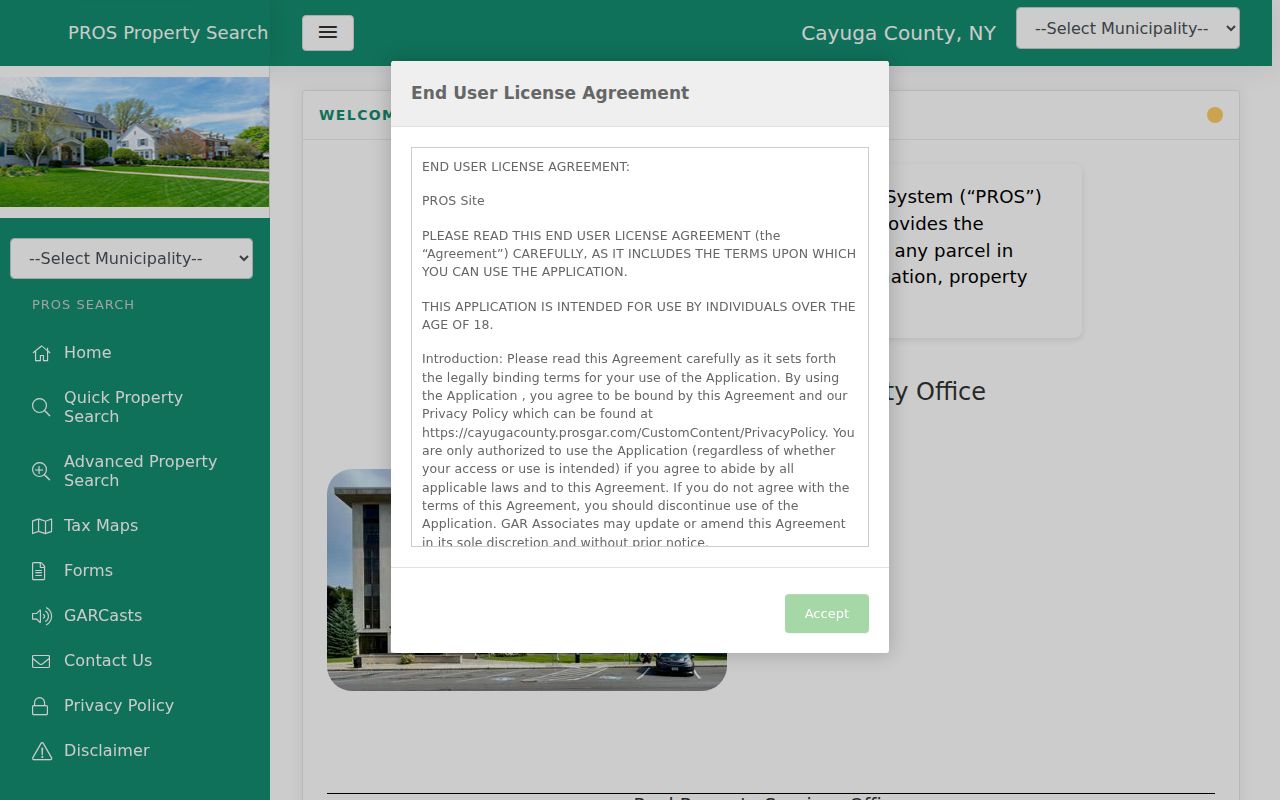
Once you find the parcel, copy its identifiers before moving on.
Auburn and the Rest of Cayuga County Use Different Roll Dates
Roll dates differ across the county. Auburn publishes its tentative assessment roll on April 1. Its final roll comes on June 1. Most other assessing units use May 1 and July 1 instead. The local assessor still handles valuation, exemption, and grievance questions. County Real Property Services maintains shared data, maps, tax rolls, and bills. Deadlines vary too. Auburn's exemption renewal date is February 1. The county cites March 1 for towns and villages. Always identify the assessing unit before treating any date as countywide.
When Cayuga County Online Records Are Not Enough
When online records run out, go to the custodian that created the record. The Clerk and Records Center handle recorded instruments and older books. The city or town assessor controls its roll. The Treasurer handles bills and delinquency. Auburn Code Enforcement keeps city permit files.
A FOIL request works for agency material not already posted. But it will not merge these separate collections. New York agencies generally have five business days to grant, deny, or acknowledge a request. They must also state an approximate response date. Describe the parcel by municipality, SBL, address, record type, and date range. That helps staff route the search.